Demonstrated Impact
Since its beginning in 2003, the Indigenous Youth Mentorship Program has impacted the lives of thousands of Indigenous children, youth, young adults, schools, and community partners across Canada.
IYMP’s impact has been demonstrated through peer-reviewed research, community-approved internal evaluations, and the lived experiences of the youth, mentors, schools, and communities who bring the program to life. Published research has shown that IYMP can support healthy living knowledge, self-efficacy, youth leadership, school connection, employability, wholistic wellness, and indicators related to type 2 diabetes prevention.1,2,3,4,5
Positive Outcomes Demonstrated in IYMP Communities
Selected IYMP evaluation outcomes have included:
- 65% improvement in emotional wellbeing†
- 80% reduction in waist circumference†
- 12% expected reduction in type 2 diabetes risk factors†
- 70% improvement in healthy food self-efficacy and quality of life†
These outcomes reflect the strength of a program rooted in Indigenous mentorship, youth leadership, community relationships, and wholistic approaches to wellbeing.
† Internal IYMP evaluation findings shared with community consent for advocacy and communications use. These findings are not published in peer-reviewed articles in keeping with community direction and Indigenous data governance principles, including OCAP® where applicable.
Evidence-based AND Indigenous led
IYMP supports positive health and wellbeing outcomes through a wholistic Indigenous approach that strengthens youth leadership, cultural identity, school connection, community relationships, and connection to land and local traditions.
Research-Informed
Peer-reviewed research has demonstrated positive outcomes for children, youth, mentors, schools, and communities.2,3,5
Community-Guided
Evaluation findings are shared according to community direction, consent, and Indigenous data governance principles.
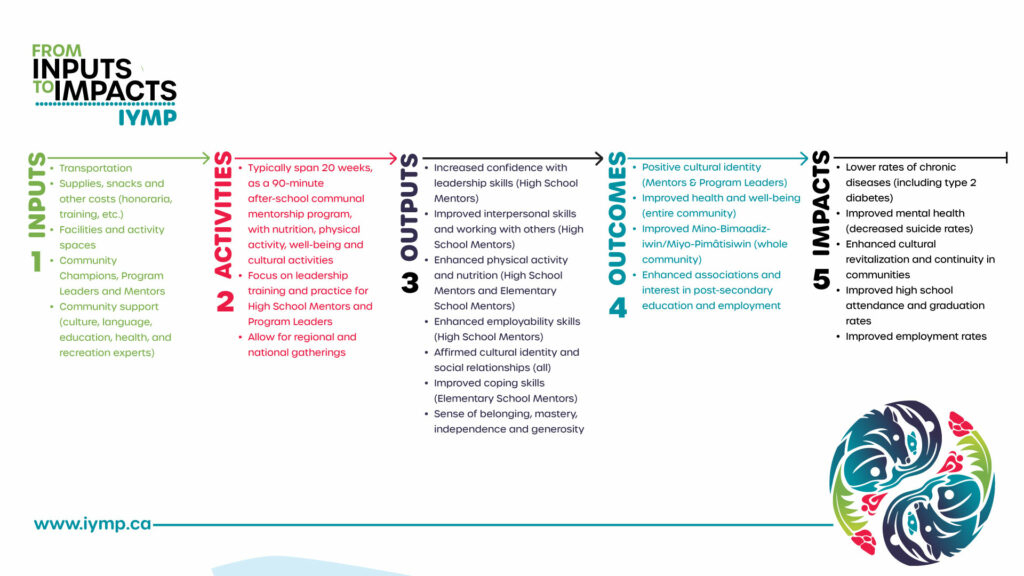
From Inputs to Outputs to Impacts
impacts aren’t just numbers; they’re our communities
"This incentive will take you places…and you'll never have to look back, because you'll be going forward" – Elder Flora Northwest
“Have mentorship in your community—it’s awesome!” – Community Champion
“I think a mentor is a role model for the kids— it gives them the encouragement to go on and do their own thing.” – High School Mentor
“… I am just trying to be the person I never had but always needed as a kid.” – High School
Are you interested in learning more about the evidence and knowledge behind IYMP?
View the complete list of IYMP publications
Sources for Impact Claims and Program Evidence
- Eskicioglu P, Halas J, Sénéchal M, Wood L, McKay E, Villeneuve S, et al. Peer Mentoring for Type 2 Diabetes Prevention in First Nations Children. Pediatrics. 2014;133(6)–31.
- Lopresti S, Willows ND, Storey KE, McHugh TLF, IYMP National Team. Indigenous Youth Mentorship Program: key implementation characteristics of a school peer mentorship program in Canada. Health Promotion International. 2021;36(4):913–23.
- Sobierajski F, Lévesque L, McGavock J, Beardy T, Montemurro G, Storey K. The essential conditions needed to implement the Indigenous Youth Mentorship Program: a focused ethnography. BMC Public Health. 2022;22(1):1–16.
- Ferguson LJ, Girolami T, Thorstad R, Rodgers CD, Humbert ML. “That’s What the Program Is All about… Building Relationships”: Exploring Experiences in an Urban Offering of the Indigenous Youth Mentorship Program in Canada. International Journal of Environmental Research and Public Health. 2021;18(2):733.
- Tiernan K, Montemurro G, Ferguson LJ, McHugh TL, Storey K. Understanding the impact of leadership experience on the educational attainment, employability, and wholistic wellness of Indigenous youth mentors in Canada: A qualitative study. Health Promotion International. 2025;40(5).
† Internal IYMP evaluation findings shared with community consent for advocacy and communications use. These findings are not published in peer-reviewed articles in keeping with community direction and Indigenous data governance principles, including OCAP® where applicable.